 the original photographs taken by Helmut Newton and printed in Vogue magazine
There is a clear picture of beauty dictated by culture industry in our minds. Outside of this beauty picture, we would be outside of our comfort zone.
"Perfection, one must conclude, is not actually perfect at all. In fact, it is almost the complete opposite. Perfection is bad. But bad is good. But bad perfection is not good, only good bad is good. It's all very simple."
(David Byrne in Odemagazine.com)
Madder Red by Yeasayer from Secretly Jag on Vimeo.
You would love the "pet" if it was a cat, a dog or a normal domasticated animal. But in the video, beside being a "lovely" image, there is an irritated image of a being. It could be a representation of a remodelling the beauty.

 'untitled_anomaly' (2008)
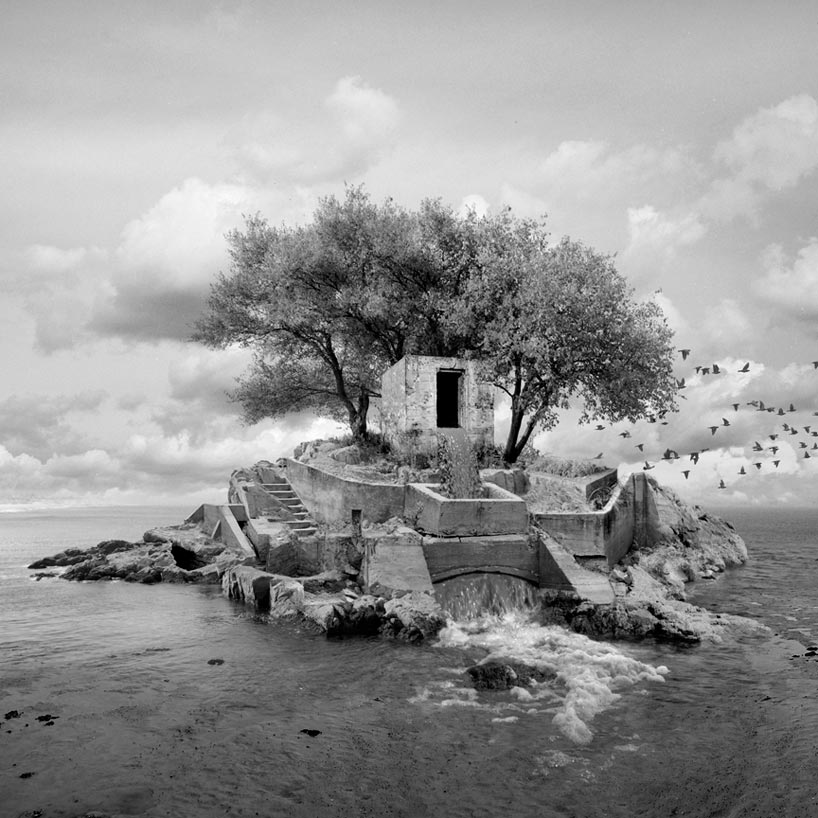 'untitled_outpost' (2008)
 Kazanjian's pictorials illustrate a fantasy-driven world that seemingly celebrates relics and decay. Having worked as a commercial CGI artist for television, fashion, and game production, his method of
creating largely involves recomposing a number of photographs in bits and pieces.
Portland art critic chas bowie comments, 'kazanjian’s aberrations occupy a state of material
transience: none of the images qualify as photographs, yet each piece is entirely photographic.
Built upon the persuasive testimonies of hundreds of anonymous snapshots and photo-documents,
kazanjian’s landscapes are entirely fictitious constructions. The photographs of aberrations serve
as souvenirs of non-existent places and events, even though their genetic codes are comprised
solely of specific, exacting details of evidence.' Bowie continues, 'by recomposing photographs (rather than shooting them), kazanjian liberates himself from the fastidious burdens of representation, although he remains tethered enough to exploit photography’s knack for maintaining its own honesty despite a track record that repeatedly suggests otherwise. In kazanjian’s hands, this freedom from naturalistic vision gives way to an uncanny space that is familiar but foreign—a fantasy both wild and gloomy.'
And Kazanjian states that “I am interested in how an image can have the potential to unfold and suggest something outside of itself. By this I mean something beyond the obvious and only discovered through a continued process of viewing. It is this act of “looking” that I find fascinating because it does not follow a linear progression like language but is interactive and random.”
For more : link
 'untitled_structure' (2007)
Chance to fashion “try hard and this might be”
– or a dystopia “don’t try hard and this might very well be”.
 La famille Bellelli
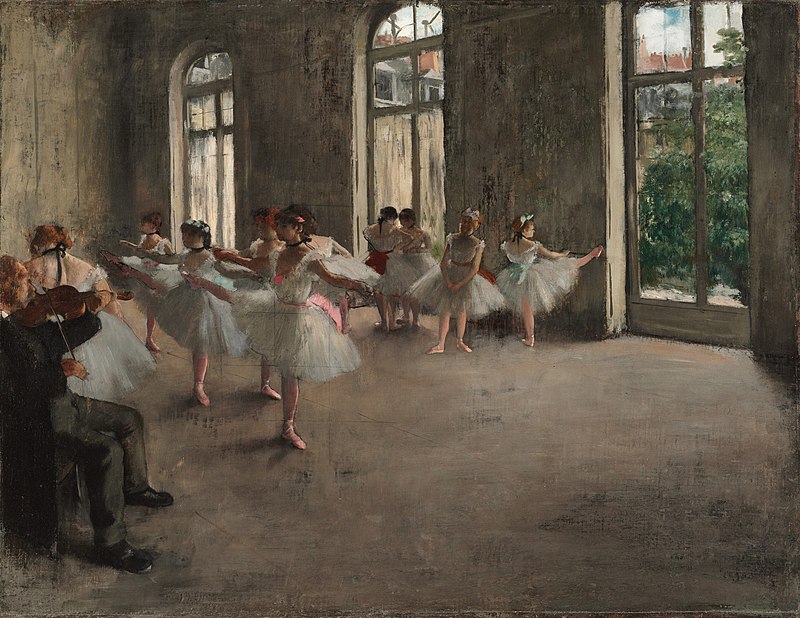 Ballettprobe
 Place de la Concorde
 Otto Mueller Zwei Mädchen im Grünen
Expressionism is an artistic style in which the artist attempts to depict not objective reality but rather the subjective emotions and responses that objects and events arouse in him. He accomplishes his aim through distortion, exaggeration, primitivism, and fantasy and through the vivid, jarring, violent, or dynamic application of formal elements. In a broader sense Expressionism is one of the main currents of art in the later 19th and the 20th centuries, and its qualities of highly subjective, personal, spontaneous self-expression are typical of a wide range of modern artists and art movements. Unlike Impressionism, its goals were not to reproduce the impression suggested by the surrounding world, but to strongly impose the artist's own sensibility to the world's representation. The expressionist artist substitutes to the visual object reality his own image of this object, which he feels as an accurate representation of its real meaning. The search of harmony and forms is not as important as trying to achieve the highest expression intensity, both from the aesthetic point of view and according to idea and human critics.
Influenced by the Fauves, Expressionism worked with arbitrary colors as well as jarring compositions. In reaction and opposition to French Impressionism which focused on rendering the sheer visual appearance of objects, Expressionist artists sought to capture emotions and subjective interpretations: It was not important to reproduce an aesthetically pleasing impression of the artistic subject matter; the Expressionists focused on capturing vivid emotional reactions through powerful colors and dynamic compositions instead. The leader of Der Blaue Reiter, Kandinsky, would take this a step further. He believed that with simple colors and shapes the spectator could perceive the moods and feelings in the paintings, therefore he made the move to abstraction.

Kandinsky's On White II (1923). Centre Georges Pompidou, Paris

